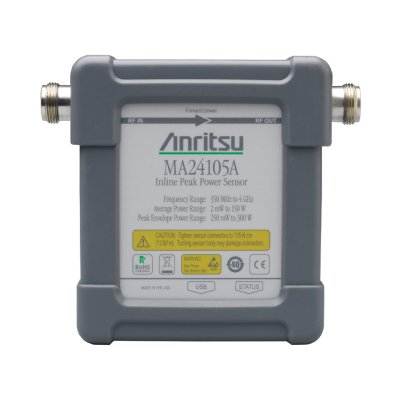
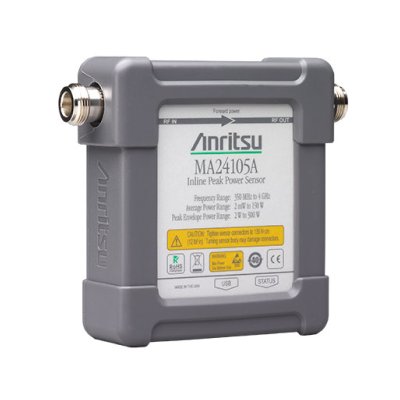
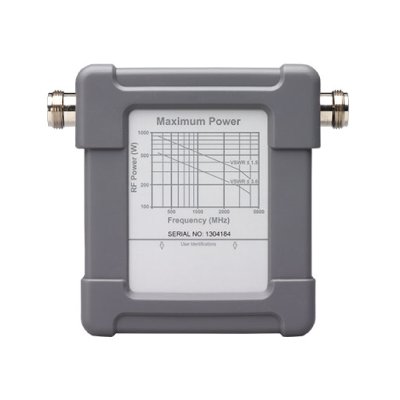
Anritsu MA2410xA : Inline Peak Power Sensor
Measure a wide variety of signals from CW to LMR, Tetra, APCO/ P25, cellular, or tactical military radar and avionics
The Anritsu MA24105A Inline Peak Power Sensor is designed to take accurate average power measurements over 2mW to 150 W, from 350 MHz to 4GHz. The sensor employs a "dual path" architecture that enables True-RMS measurements over the entire frequency and dynamic range allowing users to measure CW, multi-tone and digitally modulated signals such as GSM/EDGE, CDMA/EV-DO, WCDMA/HSDPA, WiMAX, and TD-SCDMA. The forward direction path also includes a 4 MHz bandwidth channel that has peak and comparator/integrator circuits that add measurement functions such as PEP power, crest factor, CCDF, and burst average power. Another detection circuit on the reverse direction adds reverse power measurement capabilities including reverse power, reflection coefficient, return-loss, and SWR. The presence of a micro-controller along with signal conditioning circuitry, ADC, and power supply in the sensor makes it a complete miniature power meter.
Operation with PC
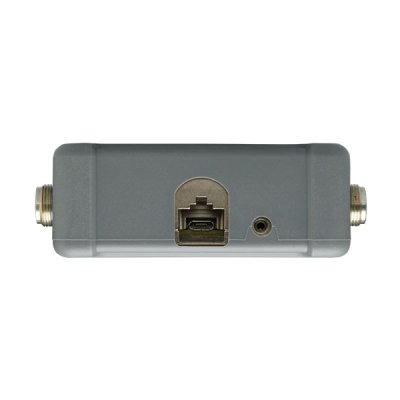
The power sensor can be used with a PC running Microsoft Windows® via USB. It comes with PowerXpert application (version 2.1 or greater) for data display, analysis, and sensor control. The software provides a front panel display making the PC appear like a traditional power meter. The application has abundant features like data logging, power versus time graph, and offset table that enable quick and accurate measurements.
SPECIFICATIONS
| Frequency Range | 350 MHz - 4 GHz |
| Dynamic Range | 2 mW to 150 W (+3 dBm to 51.76 dBm) |
| Input Return Loss | >29.5 dB, </=3 GHz >26.5 dB, </=4 GHz |
| Measurement Uncertainty | < 3.8% |
| RF Connectors | N (F) |
สินค้าที่เกี่ยวข้อง


 MakeWebEasy